

UNITREE RANGE · HUMANOID ROBOT
Unitree G1
Unitree's 1.32 m humanoid: 23 to 43 degrees of freedom, exceptional joint range, force-feedback dexterous hands and 3D LiDAR perception. The reference platform for embodied AI, research and manipulation.
G1 or G1 EDU
Same body, same sensors and same battery life: the EDU version adds dexterous hands, up to 43 degrees of freedom and full access for development.
PLATFORM
Unitree G1
• 23 degrees of freedom
• Max. knee torque 90 N·m
• Arm payload around 2 kg
• 8-month warranty
DEVELOPMENT
Unitree G1 EDU
• 23 to 43 degrees of freedom (waist and wrists as options)
• Optional Dex3-1 force-feedback dexterous hand
• Max. knee torque 120 N·m, arm payload around 3 kg
• Optional Orin module, secondary development, 18-month warranty
More flexible than a human
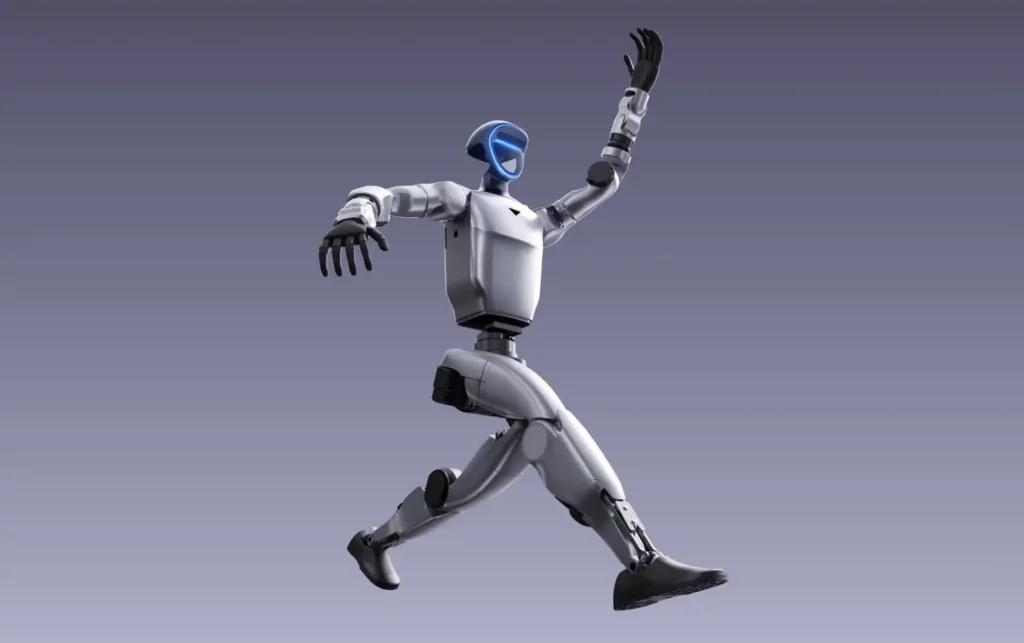
Exceptional range of motion
Waist ±155°, knee 0 to 165°, hip ±154°: postures and movements impossible for a human.
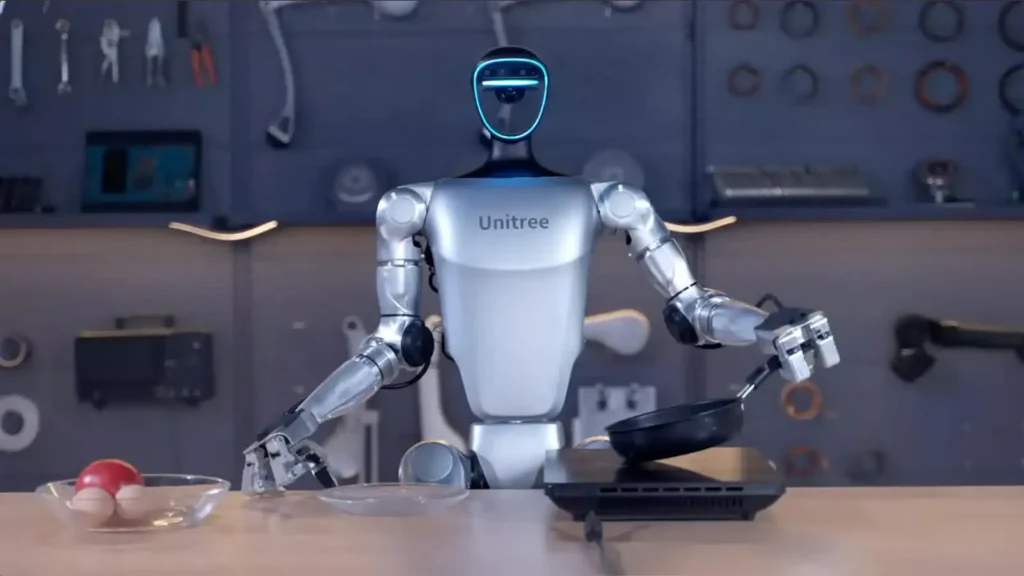
Dexterous hands
Three-finger Dex3-1 hand with 7 degrees of freedom, hybrid force-position control, optional tactile sensors (EDU).
3D perception
3D LiDAR and depth camera to perceive the environment all around the robot.
Trained by AI
Control trained through imitation and reinforcement learning, improving with every update.
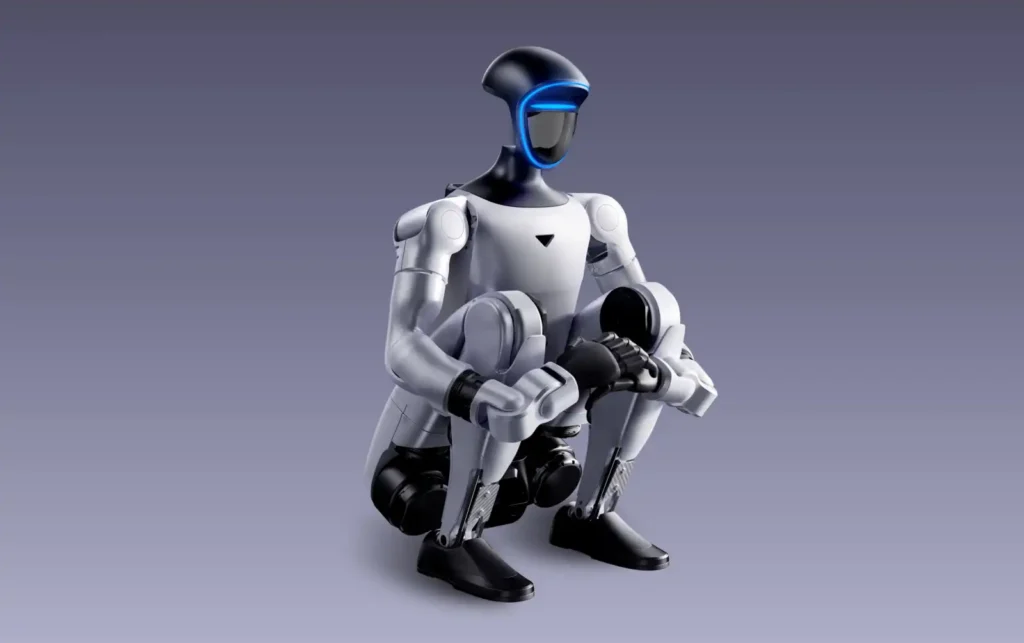
Compact and foldable
35 kg and 1.32 m standing; folded, it fits into 69 × 45 × 30 cm for transport.
Internal wiring
Cables routed inside every joint, dual encoder on each motor.
DEXTEROUS HANDS
Precise manipulation
Combined with hybrid force-position control, the Dex3-1 hand grasps and manipulates objects with finesse and reliability, like a human hand. Tactile sensor arrays are available as an option.
• Thumb with 3 degrees of freedom, index and middle fingers with 2
• 2 extra degrees of freedom at the wrist (option)
• Optional tactile sensors
RESEARCH AND DEVELOPMENT
A foundation for embodied AI
The G1 builds on UnifoLM, Unitree's unified large robotics model, and on an open ecosystem of simulation, teleoperation and datasets. The EDU version gives access to full secondary development.
• 8-core processor, optional NVIDIA Orin module (EDU)
• 4-microphone array and 5 W speaker
• Wi-Fi 6 and Bluetooth 5.2
Unitree G1 specifications
Dimensions
Standing: 1,320 × 450 × 200 mm · folded: 690 × 450 × 300 mm
Weight
Around 35 kg with battery
Degrees of freedom
G1: 23 · EDU: 23 to 43 (6 per leg, 5 per arm, waist 1 to 3)
Max. knee torque
G1: 90 N·m · EDU: 120 N·m
Arm payload
G1: around 2 kg · EDU: around 3 kg (depending on posture)
Range of motion
Waist ±155° · knee 0 to 165° · hip ±154°
Motors
Low-inertia synchronous motors · dual encoder · crossed roller bearings
Battery
9,000 mAh, 13 cells, quick-swap · 54 V 5 A charger
Battery life
Around 2 h
Computing
8-core processor · optional NVIDIA Orin module (EDU)
Perception and voice
3D LiDAR · depth camera · 4 microphones · 5 W speaker
Warranty
G1: 8 months · G1 EDU: 18 months
Indicative values, varying with configuration and operating conditions. Specifications provided by Unitree Robotics.
The reference humanoid platform
DART Solutions advises you on the configuration, integrates your use cases and connects the G1 to its control platform so you can supervise and teleoperate it remotely.
Research and education
Embodied AI, imitation learning, locomotion: an open platform widely adopted by laboratories.
Manipulation
With the dexterous hands, develop human-scale grasping and assembly tasks.
Reception and demonstrations
A compact humanoid that walks, gestures and holds a conversation, for your trade shows and reception areas.
Unitree G1 frequently asked questions
What is the difference between the G1 and the G1 EDU?
The EDU goes up to 43 degrees of freedom, can be fitted with Dex3-1 dexterous hands, gains knee torque (120 N·m) and arm payload (around 3 kg), opens up secondary development and accepts an NVIDIA Orin module. Its warranty increases from 8 to 18 months.
What is the G1's battery life?
Around 2 hours, with a quick-swap 9,000 mAh battery.
How much can the G1 carry?
Around 2 kg per arm (3 kg for the EDU). This value varies greatly depending on how far the arm is extended.
Can the G1 be programmed?
Yes, with the EDU version, which gives access to secondary development, low-level interfaces and Unitree's open-source ecosystem.
Is the G1 safe around people?
It is a powerful robot: Unitree requires a sufficient safety distance to be kept. DART Solutions trains your teams and defines the operating rules with you.
Can I see the G1 in a demonstration?
Yes. DART Solutions runs demonstrations, helps you choose the configuration and trains your teams.
A project with the G1?
Research, manipulation or reception: let's talk about your project. We help you choose the configuration and put it into service.
Contact us