

UNITREE RANGE · LIGHTWEIGHT HUMANOID ROBOT
Unitree R1
Unitree's ultralight humanoid: 1.23 m for around 29 kg, 20 to 40 degrees of freedom and a large multimodal model for voice and vision. Ready to use, easy to maintain and fully open for development.
Three versions
Same size, same agility: the version you choose determines the degrees of freedom, the vision and the access for development.
DISCOVERY
R1 AIR
• 20 degrees of freedom, 4 per arm
• Around 27 kg
• Monocular camera
• 6-month warranty
VERSATILE
R1
• 26 degrees of freedom, 5 per arm
• Articulated waist and head (2 degrees each)
• Binocular camera
• 8-month warranty
DEVELOPMENT
R1 EDU
• 26 to 40 degrees of freedom
• Optional dexterous hands
• Optional 40-100 TOPS Orin module
• Secondary development, 12-month warranty
Light, agile and open
Ultralight
Around 29 kg for 1.23 m: easy to transport, handle and deploy.
Agile
Up to 26 degrees of freedom (40 on the EDU) to walk, run, get back up and adapt to complex scenes.
Articulated head
2 degrees of freedom in the head to direct its gaze and better perceive the environment.
Voice and vision
Built-in large multimodal model, 4-microphone array, speaker and binocular camera.
Open
Fully open joint and sensor control interfaces, compatible with the main simulators.
Easy maintenance
Hollow internal wiring, quick-swap battery, ready to use straight out of the box.
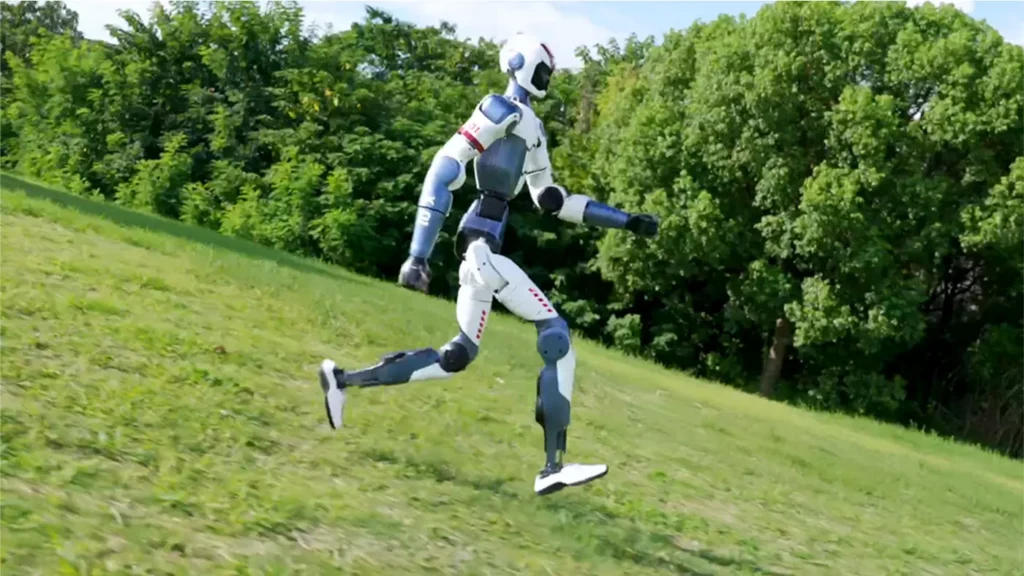
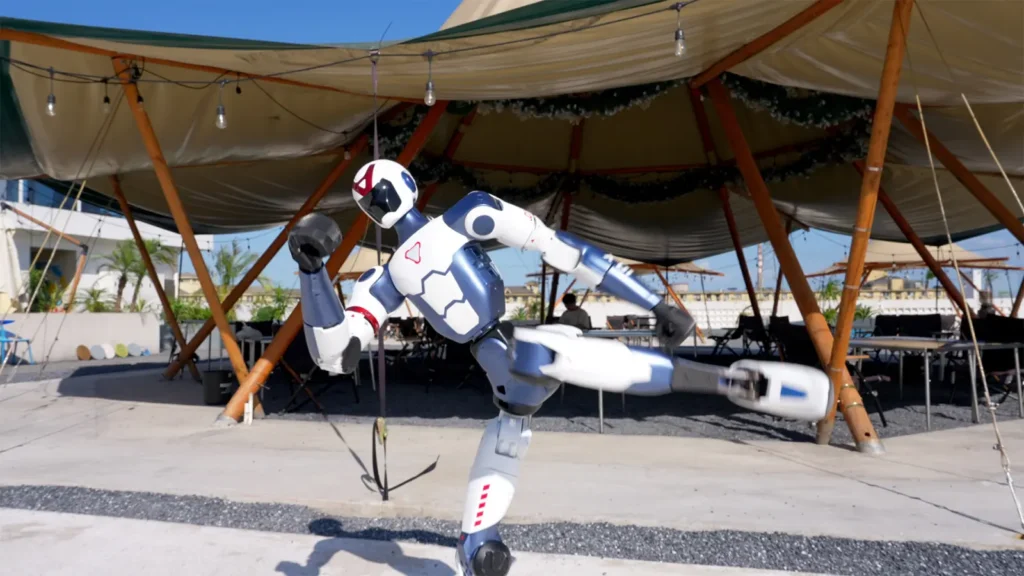
AGILITY
Movement first, tasks second
A wide range of movement is the basis of every task: the R1 walks, runs, gets back up and chains dynamic movements, with very wide joint ranges.
• Hip: yaw ±157°, pitch -168° to +146°
• Knee: -10° to +139°
• Waist: yaw ±150°, roll ±30°
DEVELOPMENT
From simulator to the real world
The joint and sensor control interfaces are fully open and compatible with the main simulation platforms: your algorithms move seamlessly from the virtual world to the real robot.
• 8-core processor, optional 40-100 TOPS NVIDIA Orin module (EDU)
• Wi-Fi 6 and Bluetooth 5.2
• Continuous OTA updates
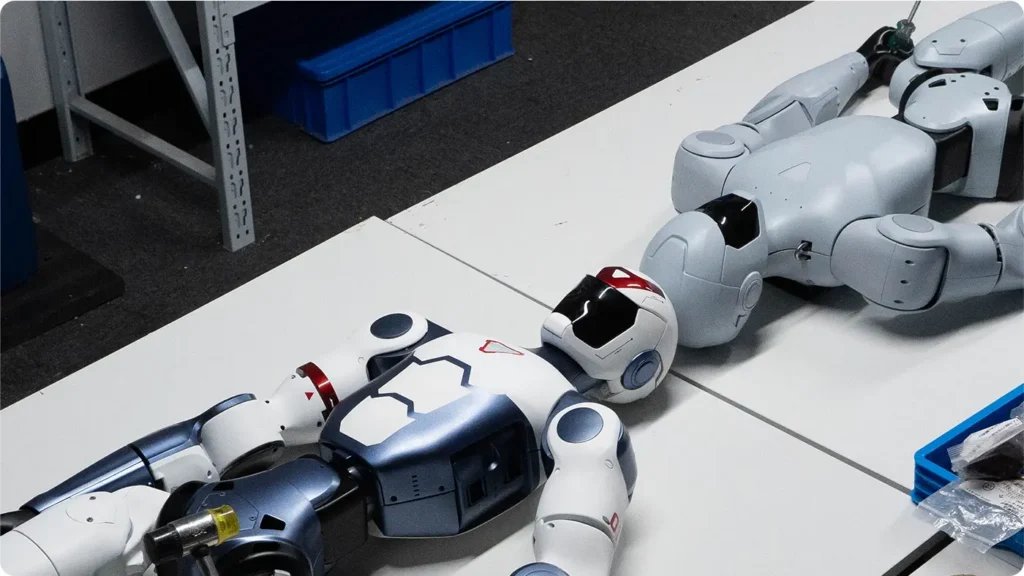
Unitree R1 specifications
Standing dimensions
1,230 × 357 × 190 mm
Weight
AIR: around 27 kg · R1 and EDU: around 29 kg
Degrees of freedom
AIR: 20 · R1: 26 · EDU: 26 to 40
Distribution
6 per leg · 4 (AIR) or 5 per arm · waist 2 · head 2
Arm payload
Around 2 kg (depending on posture)
Segments
Thigh + calf: 600 mm · upper arm + forearm: 420 mm
Motors
Low-inertia synchronous motors · crossed roller bearings
Battery life
Around 1 h · quick-swap battery
Computing
8-core processor · optional 40-100 TOPS NVIDIA Orin module (EDU)
Vision
AIR: monocular camera · R1 and EDU: binocular camera
Voice and network
4 microphones · speaker · Wi-Fi 6 · Bluetooth 5.2
Warranty
AIR: 6 months · R1: 8 months · EDU: 12 months
Indicative values, varying with configuration and operating conditions. Specifications provided by Unitree Robotics.
The accessible humanoid
DART Solutions advises you on the version, integrates your use cases and connects the R1 to its control platform so you can supervise and teleoperate it remotely.
Education and research
A light, open humanoid to train, experiment and prototype, from the simulator to the real robot.
Reception and entertainment
It holds voice conversations, recognises what it sees and livens up your trade shows, showrooms and events.
Prototyping
An affordable platform to validate a humanoid use case before scaling up.
Unitree R1 frequently asked questions
Which R1 version should I choose?
The R1 AIR (20 degrees of freedom, monocular camera) is suited to discovery. The R1 adds the articulated waist and head and binocular vision. The R1 EDU opens up development, dexterous hands and the Orin computing module.
What is the R1's battery life?
Around 1 hour. The battery swaps quickly so you can run sessions back to back.
Does the R1 have hands?
Dexterous hands are available as an option on the EDU version.
Can the R1 be programmed?
Yes, with the EDU version: open joint and sensor interfaces, compatible with the main simulators.
Is the R1 safe around people?
Despite its light build, it is a powerful robot: Unitree requires a sufficient safety distance to be kept. DART Solutions trains your teams.
Can I see the R1 in a demonstration?
Yes. DART Solutions runs demonstrations, helps you choose the version and trains your teams.
A project with the R1?
Education, reception or prototyping: let's talk about your project. We help you choose the version and put it into service.
Contact us